

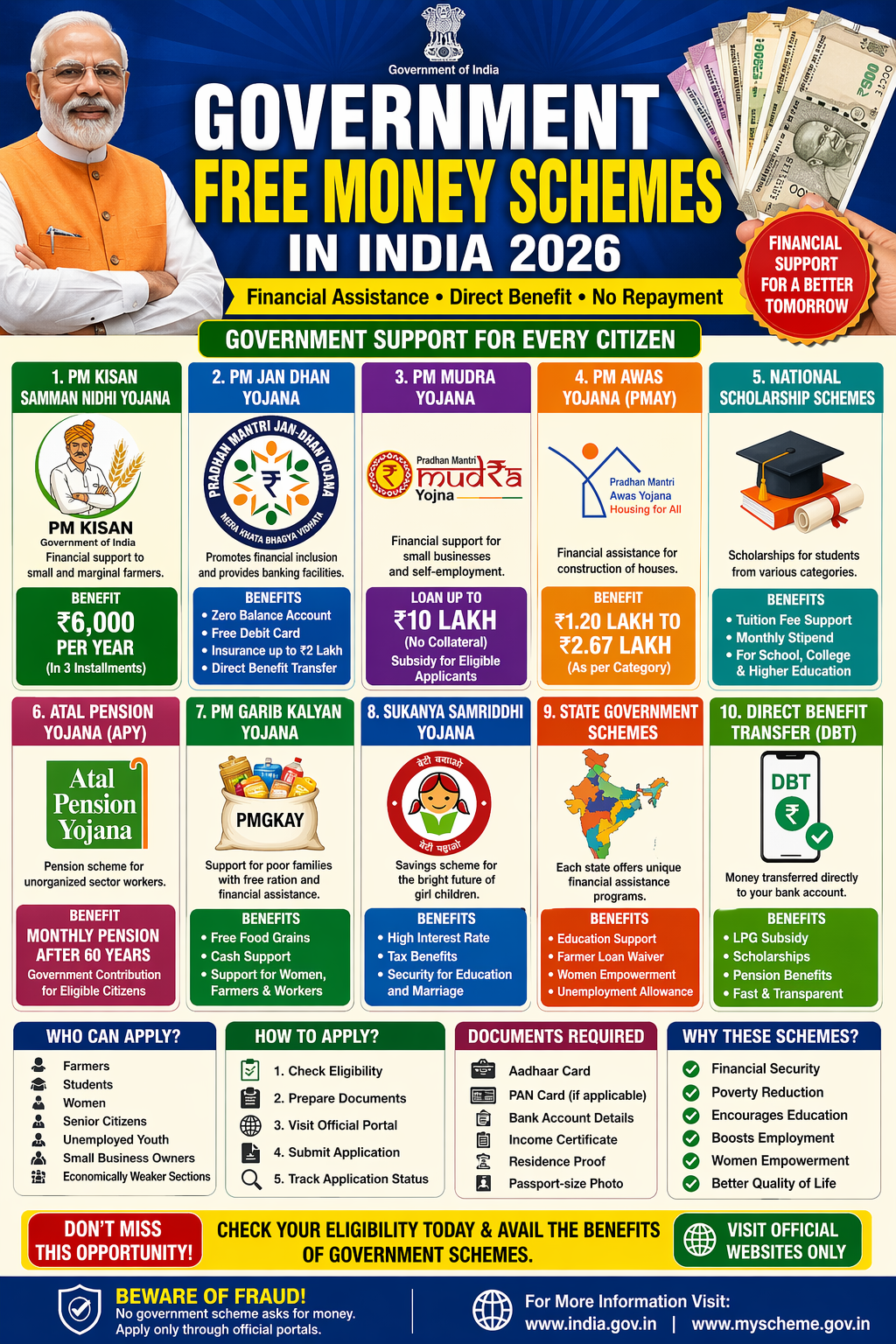
In recent years, the Government of India has introduced numerous financial assistance programs aimed at supporting citizens from different economic backgrounds. These schemes, often referred to as “free money schemes,” provide direct financial aid, subsidies, or incentives to eligible individuals without requiring repayment. Whether you are a student, farmer, unemployed youth, woman entrepreneur, or small business owner, there are multiple opportunities to benefit from these government initiatives
This comprehensive guide explores the most popular government free money schemes in India in 2026, their eligibility criteria, benefits, and how you can apply. If you are looking for financial support, this article will help you understand everything in detail
What Are Government Free Money Schemes?
Government free money schemes are welfare programs where financial assistance is provided directly to beneficiaries. These funds may come in the form of:
Direct Benefit Transfer (DBT)
Subsidies,Grants,Scholarships,Monthly allowances,Pension schemes
Unlike loans, these funds generally do not need to be repaid, making them extremely beneficial for low-income individuals and families
Top Government Free Money Schemes in India 2026
1. PM Kisan Samman Nidhi Yojana
The PM Kisan scheme is one of the largest financial support programs for farmers in India.
Key Benefits:₹6,000 per year provided in three installments
Direct transfer to bank accounts
Supports small and marginal farmers
Eligibility:Farmers owning cultivable land
Must have valid land records
How to Apply:
Visit the official PM Kisan portal
Register using Aadhaar details
Submit land and bank details
2. Pradhan Mantri Jan Dhan Yojana (PMJDY)
This scheme aims to promote financial inclusion by providing bank accounts and financial benefits.
Benefits:Zero balance bank account,Free debit card,Insurance coverage up to ₹2 lakh,Government subsidies credited directly
Eligibility::Any Indian citizen above 10 years of age
Why It’s Important: PMJDY acts as a gateway to receive benefits
from other schemes
3. PM Mudra Yojana (PMMY)
Although primarily a loan scheme, Mudra Yojana offers subsidy benefits and financial support for small businesses.
Loan Categories:
Shishu (up to ₹50,000)
Kishore (₹50,000 to ₹5 lakh)
Tarun (₹5 lakh to ₹10 lakh)
Benefits::No collateral required
Subsidy for eligible applicants
Encourages :self-employment
4. Direct Benefit Transfer (DBT) Schemes
DBT is not a single scheme but a system used by the government to transfer money directly to beneficiaries.
Examples of DBT Schemes:
LPG subsidy
Scholarship payments
Pension benefits
Advantages:
Eliminates middlemen
Reduces corruption
Faster fund transfer
5. PM Awas Yojana (PMAY)
This scheme provides financial assistance for housing.
Benefits:Subsidy on home loans
Financial support for building houses
Affordable housing for all
Eligibility:
Economically weaker sections (EWS)
Low-in:come groups (LIG)
6. National Scholarship Portal Schemes
Students can receive financial support through various scholarships.
Benefits:Covers tuition fees
Monthly stipend
Support for higher education
Target Beneficiaries:
School students
College students
SC/ST/OBC categories
7. Atal Pension Yojana (APY)
A pension scheme for workers in the unorganized sector.
Benefits:Monthly pension after retirement
Government contribution in some cases
Eligibility:Age 18 to 40 years
Must have,a bank account
8. PM Garib Kalyan Yojana
Introduced to support economically weaker sections during difficult times.Benefits:Free food grains
Direct cash transfer
Support for women and farmers
9. Sukanya Samriddhi Yojana
A savings scheme for girl children.
Benefits:High interest rate
Tax benefits:Financial security for education and marriage
10. State Government Free Money Schemes
Apart from central schemes, each state in India offers its own financial assistance programs.
Examples:Free education schemes
Farmer loan waivers
Women empowerment schemes
Unemployment allowances
1. Financial Security
Helps individuals manage basic needs.
2. Poverty Reduction
Supports low-income families.
3. Encourages Education
Scholarships help students continue studies.
4. Boosts Employment
Self-employment schemes create jobs.
5. Women Empowerment
Special schemes for women improve independence.
Common Mistakes to Avoid
Applying without checking eligibility
Providing incorrect details
Missing deadlines
Not linking Aadhaar with bank account
Falling for fake websites
How to Identify Genuine Schemes
Always visit official government websites
Avoid agents asking for money
Verify scheme details through trusted sources
Check government announcements
Latest Updates on Free Money Schemes in 2026
Increased focus on digital transfers
More schemes for women and youth
Enhanced benefits for farmers
Simplified application process
Who Can Benefit from These Schemes?
Government free money schemes are designed for:
Farmers
Students
Women
Senior citizens
Unemployed youth
Small business owners
Economically weaker sections
How to Apply for Government Schemes
Follow these general steps:
1. Check Eligibility
Read the official guidelines carefully.
2. Prepare Documents
Aadhaar card
Bank account details
Income certificate
Address proof
3. Visit Official Portal
Apply through government websites.
4. Submit Application
Fill out the form and upload documents.
5. Track Status
Use your application ID to check updates.
Documents Required
Most schemes require:
Aadhaar Card
PAN Card (if applicable)
Bank Account Details
Income Certificate
Residence Proof
Passport-size photo
Benefits of Government Free Money Schemes
Conclusion
Government free money schemes in India are powerful tools to support citizens financially and improve their quality of life. With a wide range of programs available for different sectors, it is important to stay informed and take advantage of these opportunities. By understanding eligibility criteria, application procedures, and benefits, you can maximize the support provided by the government.
If you are eligible for any of these schemes, do not hesitate to apply and secure financial assistance for your further
Please help